1750 – Normandy
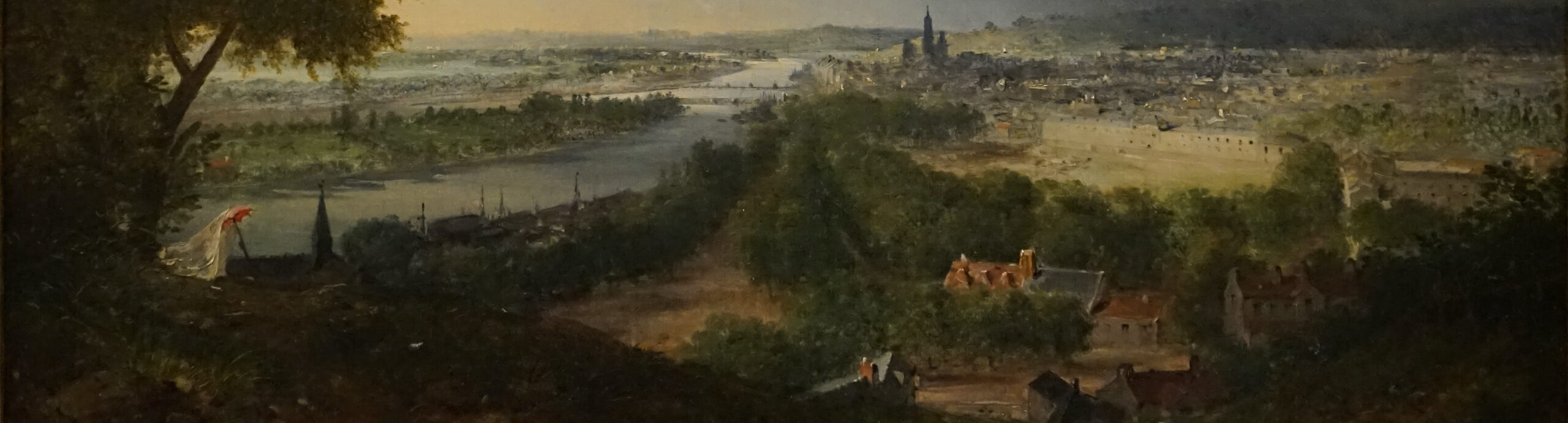
Vue de Rouen… (detail) Bouton, Charles-Marie. Musée des Beaux-Arts de Rouen. (circa 1825)
1750 Normandy
Normandy’s immense size makes Normandy different from Paris and Saint Domingue, both of which are essentially tiny islands in terms of space. In 1750, Normandy had its own languages, its own cultures, and its own history – quite independent of Paris and eastern and southern France and often at odds with Louis XV and the Church, which ruled France. Feudal values, regional power, and clear divisions between the rights and privileges of the nobility and the clergy, on the one hand, and the taxes and other burdens imposed on all others, regulated life in Normandy, and the other communities of regions which comprised the France, the kingdom. By 1791, the year of Géricault’s birth, these political systems had utterly collapsed. Many of Normandy’s unique social and cultural customs survived, however.
Slavery and the slave trade was an important componant of Normandy’s economy in 1750, particularly in the ports Rouen and Dieppe. Sugar from Saint Domingue and Martinique was imported into Normandy and re-exported into Europe. Indigo from France’s Caribbean colonies was used in Roun’s textile industry. Tobacco grown by slaves was used to produce tobacco products in the royal tobacco manufactory in Dieppe. Rouen and Dieppe were among first French cities to establish trading forts, or factories, in Senegal on the west African coast in 1633.
In 1748, Marie-Thérèse De Poix, one of two daughters of the manager of the royal tobacco manufactory in Dieppe married Pierre-Antoine Robillard the son of one of the king’s paymasters. Pierre-Antoine Robillard, Jacques-Florent Robillard at the royal tobacco manufactory in Paris, and the Saint Domingue Robillards belonged to one family and were very close. In 1750, Louise-Thérèse De Poix, the sister of Marie-Thérèse De Poix, married Jean-Vincent-Charles Caruel, a lawyer employed by the high court of Rouen. Louise Thérèse and Jean-Vincent-Charles produced five children together: three daughters and two sons. Their eldest daughter, Marie-Jeanne-Louise Caruel, married Georges-Nicolas Géricault, a lawyer also employed by the high court of Rouen, in 1790. Their only child: Jean-Louis-André-Théodore Géricault was born a year later on September 26, 1791. Marie-Jeane-Louise Caruel was thirty-eight years old at the time of Théodore’s birth. Georges-Nicolas Géricault was fifty.
Nicolas sieur de la Vergée Géricault
(circa 1684 – 1736 07 09)
Renée Herbert
– 1717 04 11
Robert-Nicolas Géricault 1707
– Marries Anne Bonnesœur 1738 07 21
André Géricault 1710 03 09
André Géricault 1794
Marie-Anne Géricault 1711 08 – 1759 10 27
Marries Etienne Lasne 1735 01 18
Oüen Géricault 1714 05 21 – 1743 02 23
Marries Marguerite-Charlotte Haÿe 1740 02 23
Françoise Géricault 1717 04 10
Anne Bonnesœur & Robert Nicolas Géricault
Marie-Anne Géricault & Etienne Lasne
Marguerite-Charlotte Haye & Ouen Géricault
Robert-Nicolas Géricault 1707
– Marries Anne Bonnesœur 1738 07 21
Guillaume-François Géricault
André Géricault 1794
Ouen Géricault 1717 05 21
Marries Marguerite-Charlotte Haye 1740 02 23